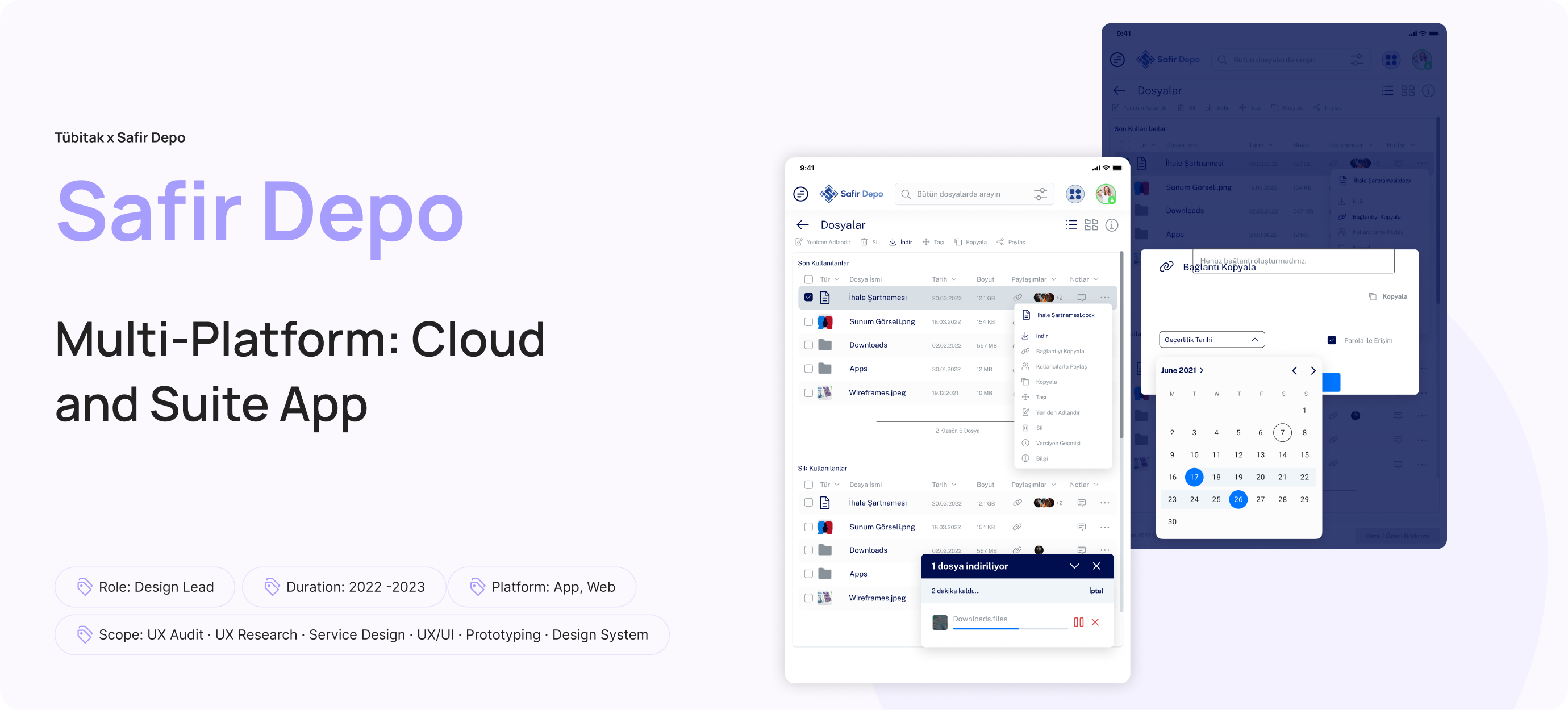
Redesigning a secure enterprise cloud experience
for Tübitak Safir Depo
Safir Depo was redesigned to make secure file management easier to understand, navigate and use across web, mobile and suite applications.From information architecture to encrypted file experiences, the project focused on creating a more coherent and sustainable product experience across multiple platforms.
A powerful enterprise tool that had become difficult to understand
Safir Depo was designed as an internal cloud application for government employees, providing a secure and local environment for storing and sharing files.
As the product evolved, however, the experience became increasingly difficult to navigate.
Web and mobile experiences had been designed separately. Navigation patterns were fragmented, important features were distributed across different areas, and the encrypted file experience introduced additional complexity for users.
The challenge wasn't simply to improve the interface.We needed to make a complex and security-focused product easier to understand, while creating a foundation that could work consistently across platforms.
01 — The Challenge
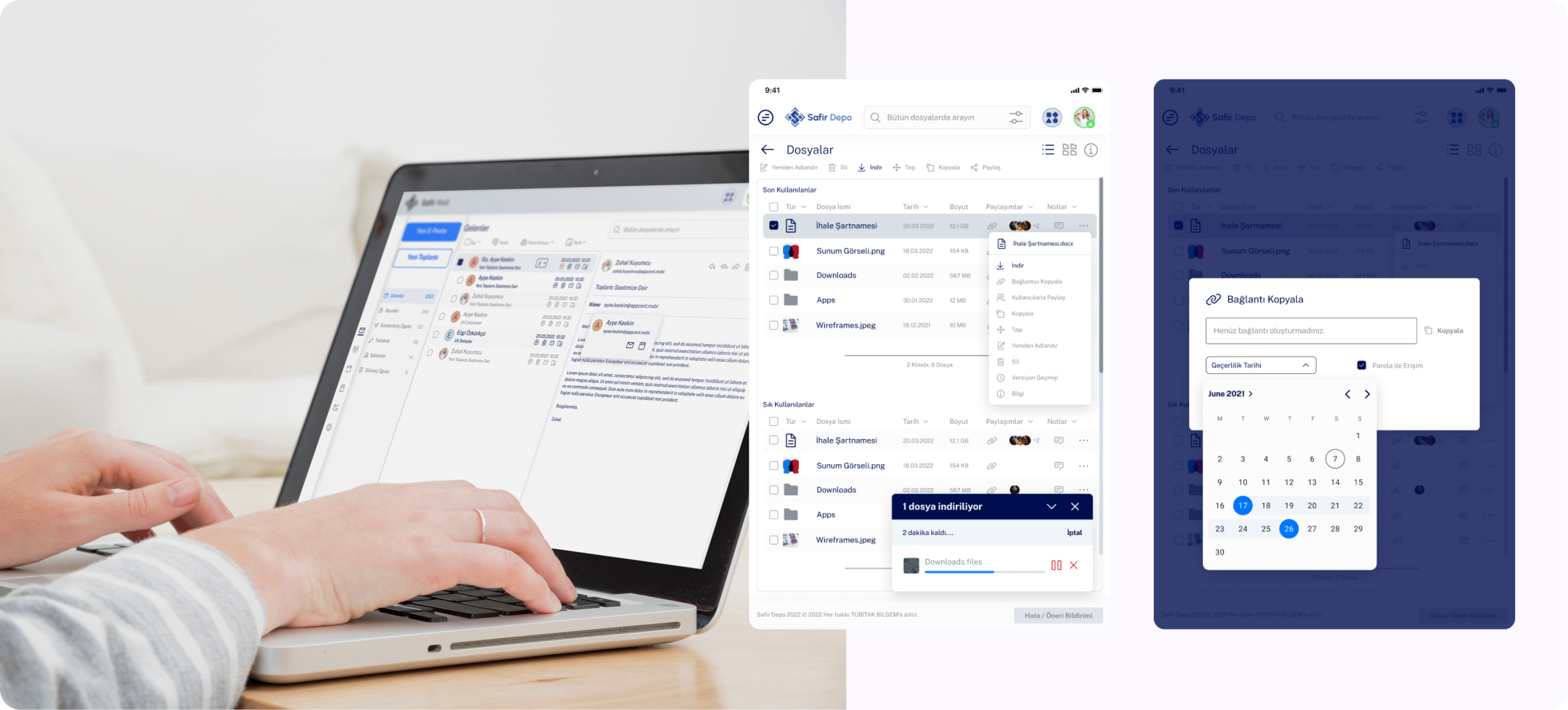
From understanding the product to shaping the experience
I managed the design process from user research and product understanding through UX design, visual direction and final UI delivery.
My contribution covered:
- User research and persona analysis
- Product and UX evaluationInformation architecture
- User flows and interaction design
- Web and mobile experience design
- Encrypted file experience
- Navigation and search restructuring
- Design system direction
- Suite application designUX/UI design
- Collaboration through final development delivery
Rather than treating each platform or feature independently, I focused on creating a shared experience model that could scale across the Safir Depo ecosystem.
02 — My Role
Before redesigning the interface, we looked at how the product was actually being used
The first step was understanding where complexity was coming from.
The product had accumulated different navigation patterns, duplicated functionality and platform-specific solutions.
On mobile, both a hamburger menu and bottom navigation were being used, creating multiple paths to reach information.
On web, related features were sometimes separated across different areas of the product.
The result was an experience where users had to understand the structure of the product before they could confidently use it.
This became the foundation for rethinking the information architecture rather than simply redesigning individual screens.
03 — Understanding the Existing Experience
Turning complexity into clearer design opportunities
The problems we identified were not isolated UI issues.They pointed to broader opportunities within the product:
Simplify
Reduce unnecessary steps and make important actions easier to understand.
Connect
Bring related features together instead of distributing them across different areas.
Clarify
Make security-related states and system behaviour visible without overwhelming the user.
Unify
Create a shared experience language across web and mobile.
Scale
Establish reusable patterns that could support the product as it evolved.These principles shaped the direction of the redesign.
04 — From Findings to Opportunities
One product, different ways of working
Safir Depo served users with different levels of familiarity and different reasons for interacting with the product.
Some users primarily managed files and folders. Others needed to find shared documents, access recent files or work with encrypted content.
Instead of designing a single path for everyone, we looked at common behaviours and created shared solutions that could work across different user profiles.
This helped us move from feature-driven design toward a more user-oriented structure.
The goal was to make the most relevant actions easier to discover without adding another layer of complexity.
05 — Designing Around Different User Contexts
Making the product easier to understand at a glance
One of the biggest opportunities was restructuring the information architecture.
The mobile experience previously relied on both hamburger navigation and bottom navigation. We restructured the architecture so information could be accessed through a clearer, more unified structure.
On web, related functionality that had previously been positioned in separate areas was brought together.
The result was a simpler relationship between:
- Files
- Folders
- Recent activity
- Shared content
- Encrypted storage
- Search
- File actions
Rather than asking users to understand where a feature lived, the experience was redesigned around what they were trying to accomplish.
06 — From Navigation to Information Architecture
Helping users find what matters faster
File management was at the centre of Safir Depo, so discovery needed to be more contextual.
The existing search experience lived in a separate tab, creating unnecessary separation from the content users were already working with.
We repositioned search within the relevant screens and kept it more visible and accessible.
We also strengthened the file experience with quick access patterns such as:
- Recently viewed
- Frequently used
- Shared with me
This transformed file discovery from a separate task into a more integrated part of the everyday workflow.
07 — Designing a More Useful File & Search Experience
Security shouldn't create uncertainty
One of Safir Depo's biggest differences from conventional cloud storage products was its encrypted file experience.
The challenge was not only to provide encryption, but to help users understand when and how the encrypted storage mode was being used.
The existing experience did not make this state sufficiently clear.
We redesigned the interface to communicate the encrypted mode without competing with the actual content.
The principle was simple:
Make security visible — without making it distracting.
This allowed a complex technical capability to become a clearer part of the everyday experience.
08 — Making Security Easier to Understand
Establishing a system before scaling the product
Once the core experience was defined, we translated the new information architecture and interaction patterns into a shared visual system.
The existing product lacked a consistent hierarchy for visual elements and actions, which made similar interactions feel different across the experience.
We established clearer rules for:
- Visual hierarchy
- Action hierarchy
- Navigation
- Content structureInteraction patterns
- Components
- System states
This created a more sustainable design foundation instead of solving the same interface problem repeatedly.
09 — From Wireframes to a Scalable Interface
One product language, adapted to different contexts
Safir Depo needed to work across responsive web, Android, tablet and iOS experiences.
The goal was not to make every platform identical.
It was to create a shared product language while adapting the experience to the context of each device.The redesign therefore connected:
Web → Mobile → Tablet → Suite applications
through common information architecture, interaction principles and visual patterns.
This helped transform separately developed experiences into parts of the same product ecosystem.
10 — Designing Across Web & Mobile
Extending the experience beyond the core product
The redesign also revealed gaps in the existing ecosystem.
Some suite applications were missing entirely, creating an opportunity to extend the product experience beyond the core cloud application.
Rather than treating these as standalone products, we designed them as part of the same Safir Depo ecosystem.
This meant carrying the same design principles, interaction patterns and visual language into new experiences.
The product could therefore grow without creating another layer of fragmentation.
11 — Designing What Was Missing
Designing the relationships between the experiences
The redesign brought together the different parts of Safir Depo into a more connected system.
Files connect to search.
Search connects to file actions.
File actions connect to sharing, copying and moving.
Encrypted storage becomes part of the same file-management experience.
And the same product language continues across web and mobile.
Instead of designing each screen or platform independently, we focused on the relationships between them.
The result was a more coherent experience for a product with increasingly complex capabilities.
12 — From Fragmented Platforms to One Connected Experience
A clearer foundation for a complex enterprise product
The Safir Depo redesign transformed a fragmented set of platform experiences into a more structured and sustainable digital product.
We simplified the information architecture, made file discovery more contextual, clarified the encrypted file experience and established a shared design system across platforms.
More importantly, the project created a foundation that could support different user profiles, new suite applications and future product development without continuously adding complexity.
From a complex enterprise tool to a clearer, more connected and scalable digital experience.
13 — The Result
Product Strategy · UX Research · UX/UI · Design Systems · Design Leadership
Designing experiences, products and systems that make complexity easier to navigate.
Product & UX DesignI work from problem definition and discovery through information architecture, user flows and interaction design. I use research, audits and product insights to turn complex requirements into clear experiences.
Product & UX DesignI work from problem definition and discovery through information architecture, user flows and interaction design. I use research, audits and product insights to turn complex requirements into clear experiences.
Product & UX DesignI work from problem definition and discovery through information architecture, user flows and interaction design. I use research, audits and product insights to turn complex requirements into clear experiences.
Design TrainingsApplied Individual and Corporate Trainings, Internship and Graduation Project Follow-up, One-to-One Mentoring