Redesigning the end-to-end self-service
baggage experience for Pegasus
From the kiosk interface to the physical bag drop experience, Express Bagaj was redesigned to create a faster, clearer and more confident self-service journey for passengers.
A self-service experience that had become increasingly complex
Express Bagaj was created to help passengers complete check-in and baggage drop without waiting at traditional counters.
But as passenger profiles changed, new features were introduced and operational needs evolved, the existing experience started to reveal new problems.
Usage was declining, error rates were increasing and the physical limitations of the kiosks made some interactions difficult.
At the same time, incomplete sessions, unclear baggage instructions and an inflexible software structure created challenges not only for passengers, but also for airport operations.
The challenge was no longer simply to redesign the interface.
We needed to rethink the entire self-service baggage experience.
01 — The Challenge
From understanding the problem to shaping the experience.
I was involved throughout the design process, from discovery and research to prototyping, testing and final experience design.
My responsibilities included:
- User research & field observations
- Workshop facilitation
- Data & existing experience analysis
- Persona development
- Customer journey mapping
- Use cases & user flows
- Wireframing
- Prototyping & usability testing
- UX/UI designInteraction & motion design
- Physical experience considerations
- Illustration & visual communication
- Collaboration with software and operational teams
Rather than treating the kiosk as an isolated interface, I focused on understanding how the passenger, the technology and the airport environment interacted as one service.
02 — My Role
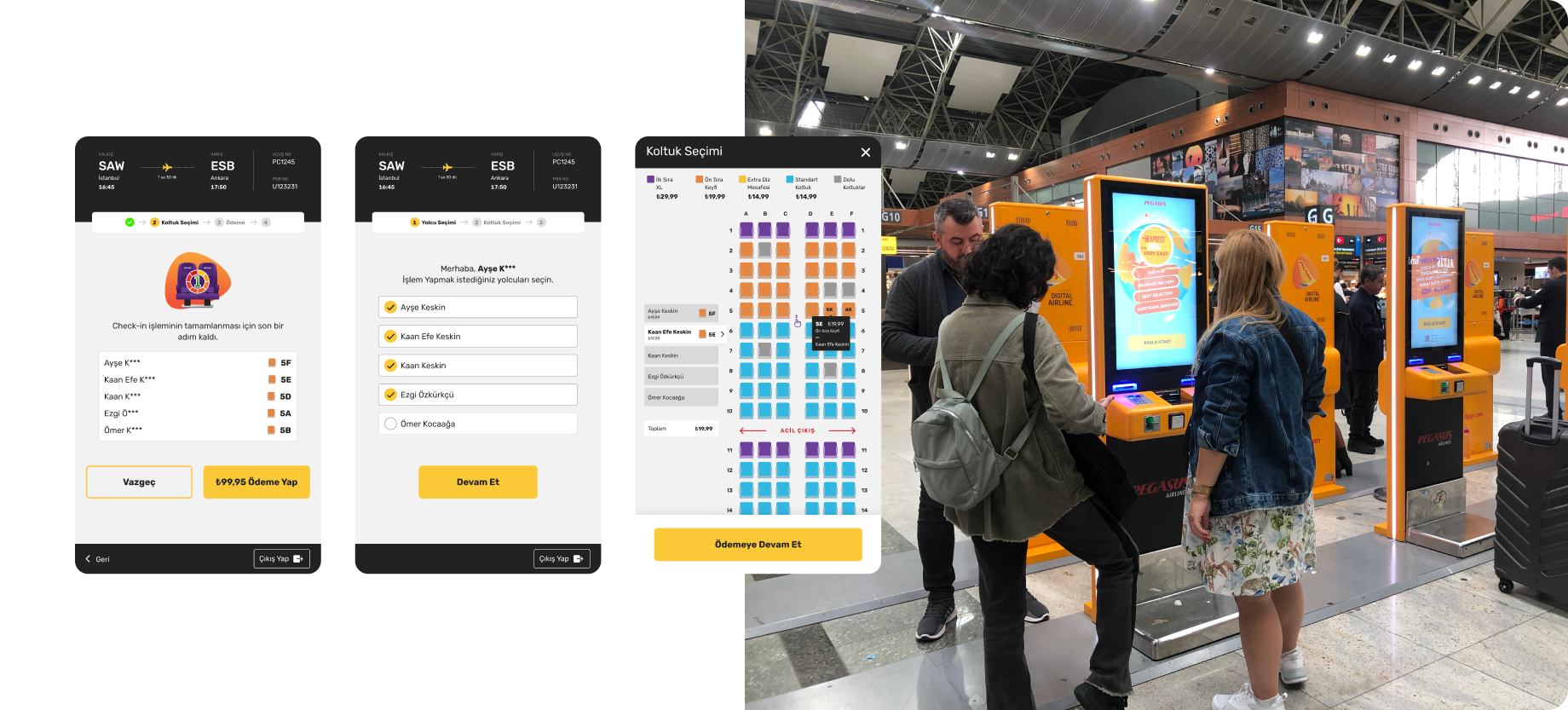
Before redesigning the interface, we went into the field
The experience couldn't be understood from screens alone.
We combined stakeholder workshops, existing interface analysis, user data, feedback and extensive field observations to understand what was actually happening at the airport.
This helped us uncover problems that weren't immediately visible in the interface — from passenger hesitation and incorrect baggage placement to operational dependencies and incomplete sessions.
The research became the foundation for deciding what needed to change, why it needed to change and where the experience needed to go next.
03 — Understanding the Experience
.png)
From a task-based interface to a guided experience
Our research showed that passengers didn't simply need faster interactions.
They needed confidence.
Especially for passengers using self-service for the first time, uncertainty appeared at almost every stage:
What should I do next?
Did I do this correctly?
What happens if something goes wrong?
Is my baggage actually being sent?
We therefore shifted the experience from simply presenting actions to continuously guiding passengers through them.
Clearer hierarchy.
Persistent context.
Visible progress.
Earlier guidance.
Stronger feedback.
04 — FROM FRAGMENTED TO GUIDED
Designing around real passenger behaviour
A self-service journey doesn't look the same for every passenger.
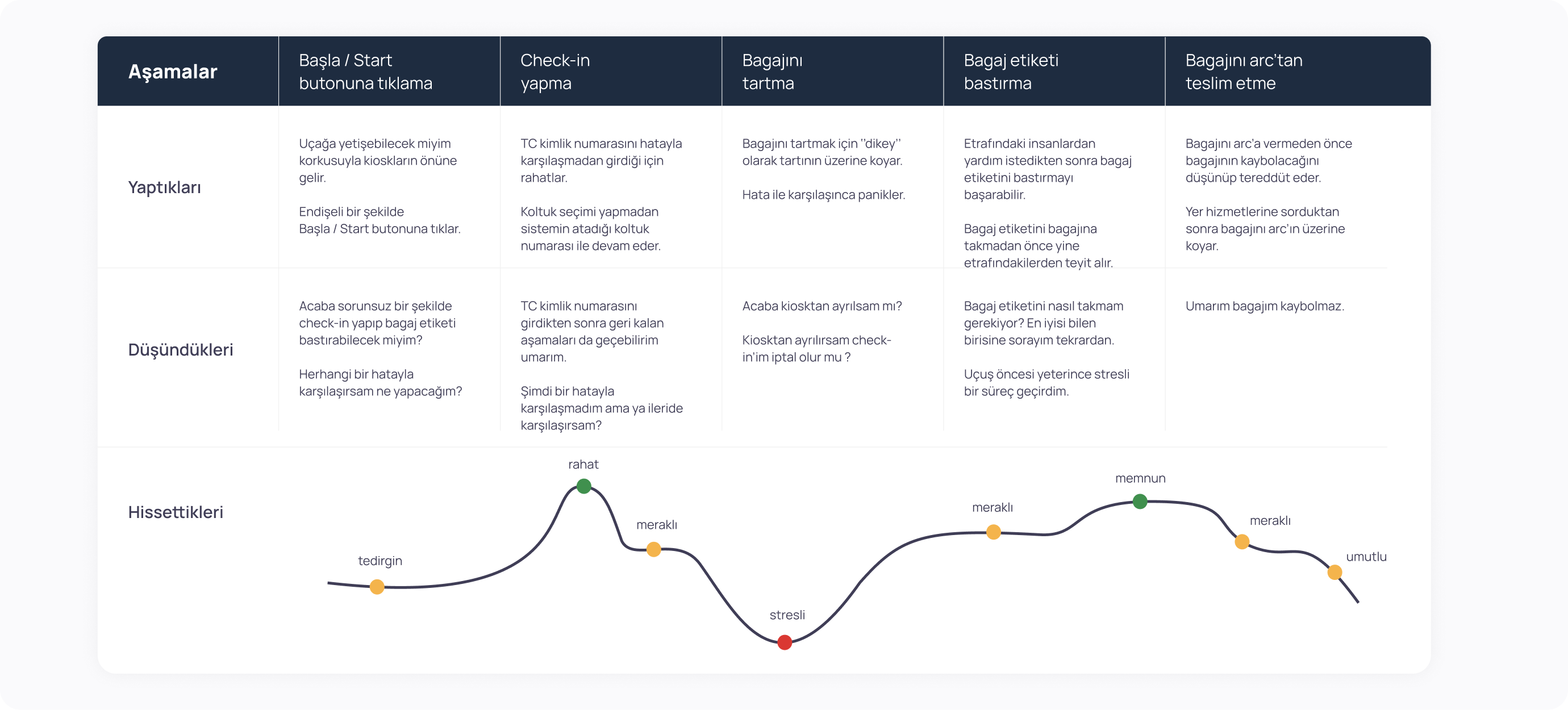
Through field observations, we identified different passenger profiles and mapped their behaviours, needs, emotions and barriers throughout the experience.
One particularly important profile was the unprepared and stressed passenger — someone unfamiliar with the kiosk, unsure about what to do next and likely to abandon the process after encountering an error.
Mapping this journey helped us identify moments where the interface needed to do more than provide information.
It needed to reduce anxiety, confirm progress and create confidence.
05 — DESIGNING AROUND THE PASSENGER
Designing within the physical constraints of the kiosk.
The kiosk itself couldn't be redesigned physically, so the interface had to adapt to its existing dimensions and interaction constraints.
We created a hidden interaction grid to define where critical information and actions should live.
Flight information was kept visible throughout the journey, while step indicators helped passengers understand where they were and what remained.
The result was a more structured interface that worked with the physical environment instead of against it.
06 — Redesigning the Kiosk

Designing new journeys without disrupting the core experience
The redesign also created a foundation for introducing new services.
We designed new journeys such as:
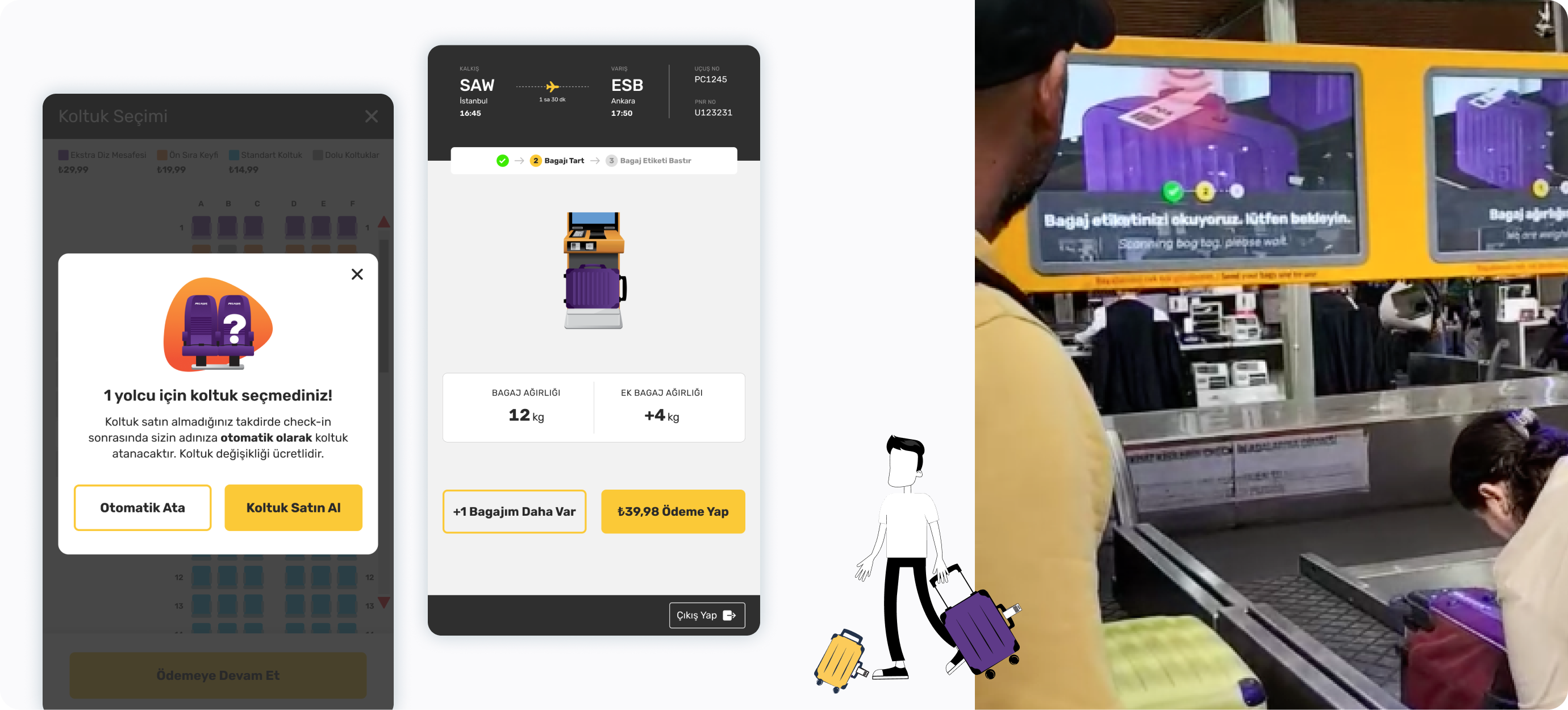
Paid seat selection
Integrating additional seat selection into the self-service flow.
Paid cabin baggage
Helping passengers without included cabin baggage discover, purchase and complete the additional baggage journey.
Lucky Passenger
Allowing eligible passengers to check their cabin baggage into the aircraft hold free of charge.
These journeys were designed parametrically so they could be introduced, removed or adjusted without breaking the core self-service experience.
07 — DESIGNING WHAT WAS MISSING
From kiosk to bag drop
The Express Bagaj experience doesn't end at the kiosk.Pegasus separates the baggage journey into two connected stages:
01 — Kiosk
Check-in, baggage weighing and baggage tag printing.
02 — Bag Drop / Arc
The passenger places the tagged baggage onto the bag drop unit and completes the process.
Although the second stage requires very few actions, problems at this point could create long queues, increase dependency on ground staff and negatively affect the passenger's overall flight experience.
This meant the bag drop couldn't be treated as a separate physical machine.
It had to become part of the experience.
08 — BEYOND THE SCREEN
Designing beyond the interface
The Arc experience revealed that interaction wasn't limited to the screen.
Passengers often didn't notice the instructions, waited for staff assistance or left their baggage before the process was complete.
We therefore redesigned the experience as a combination of interface, animation, sound and light.
The Arc screens were physically repositioned to improve visibility.
Animated instructions were supported by keyboard sounds, confirmation and error sounds, and lighting cues.
Each element was designed to communicate the system's state and guide the passenger toward the next action.
The interface became something passengers could see, hear and understand.
09 — DESIGNING THE PHYSICAL EXPERIENCE
Making every action feel confirmed
One of the biggest problems in the bag drop journey was uncertainty.
Passengers needed to know whether their baggage had been recognised, whether the process was still running or whether their baggage had successfully been sent.
We introduced clearer system states, progress information and stronger visual feedback.
Instead of leaving passengers to interpret what was happening, the system continuously communicated its state.
Scan.
Process.
Confirm.
Complete.
Every stage became visible, understandable and actionable.
10 — FROM UNCERTAINTY TO FEEDBACK
From a collection of interactions to one connected journey
The redesign shifted our focus from individual screens to the experience of the entire baggage journey.
The kiosk, baggage tag, Arc, animation, sound, lighting and physical environment were designed as connected parts of the same service.
This allowed us to create a more coherent experience for passengers while also reducing friction for airport operations.
A digital interface became part of a physical service.
11 — FROM A COLLECTION OF SCREENS TO A CONNECTED SERVICE
A self-service experience designed for scale
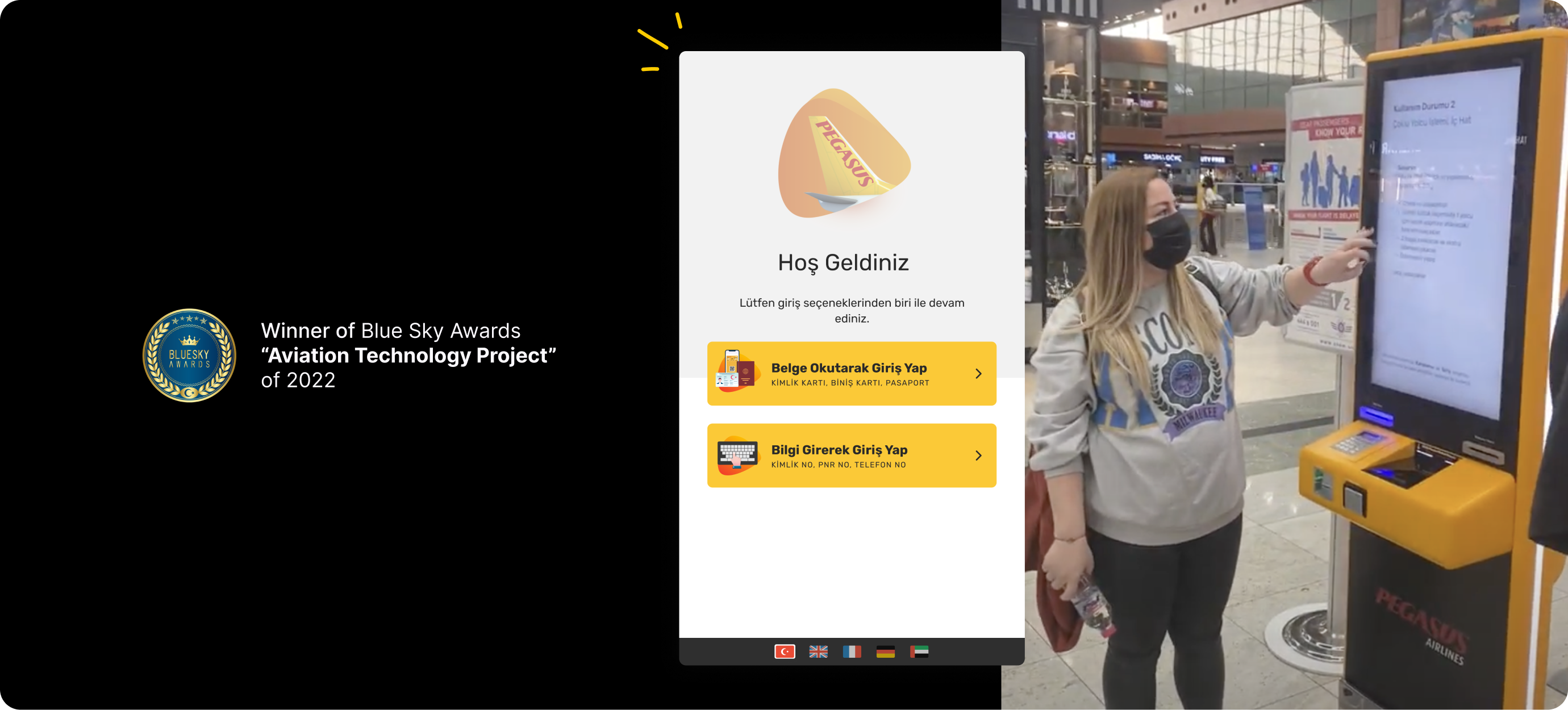
Express Bagaj is now used across 8+ airports and by 10,000+ passengers every day, enabling passengers to complete check-in and baggage drop in less than five minutes.
The project was also recognised with the BlueSky Awards 2022 — Aviation Technology Project of the Year.
But the outcome wasn't only a redesigned interface.We created a more flexible experience that could evolve with new passenger needs, new services and changing operational requirements.
From a difficult self-service process to a more guided, connected and scalable passenger experience.
12 — THE RESULT
A service design strategy built for continuous evolution
Redesigning the experience once wasn't enough.
The product needed to accommodate new features, changing passenger behaviours and evolving airport operations without repeatedly rebuilding the entire experience.
Understand
Observe the real experience before designing the interface.
Connect
Design digital, physical and environmental interactions as one service.
Scale
Create flexible patterns that allow the experience to evolve without breaking the core journey.
The result was more than a kiosk redesign.
It was a foundation for continuously evolving the self-service baggage experience.
13 — THE STRATEGY
Other Works



.png)
